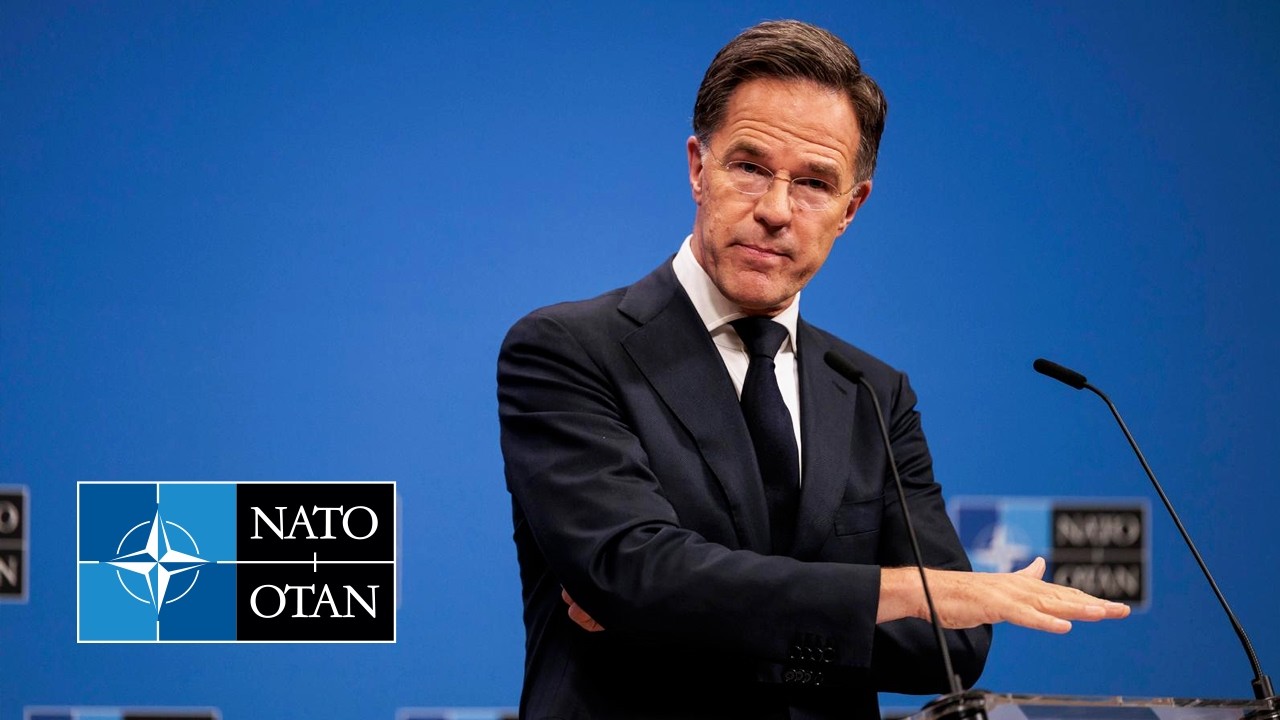
NATO Sec Gen : Cash is crucial, but you cannot stop a missile or a tank with a dollar or a euro
Press conference
by NATO Secretary General Mark Rutte following the meetings of NATO Ministers of Defence in Brussels, Belgium
18 June 2026
Good afternoon. We have just finished the last meeting of NATO defence ministers before the Ankara Summit, and we made good progress on our priorities.
Spending more, and better, on the forces and capabilities we need to defend every inch of Allied territory. Around the table today I heard Ally, after Ally, after Ally explaining how they are increasing investment in defence.
There is a strong commitment to get defence spending to 5% of GDP by 2035. Some Allies will already get there this year, way ahead of schedule. European allies and Canada are really stepping up with record increases last year, over $90 billion extra in real terms, which means $139 billion extra in nominal terms. I repeat, $139 billion extra.
Cash is crucial, but you cannot stop a missile or a tank with a dollar or a euro. We need to turn the cash into combat-ready capabilities, and fast. This is our shared priority for the Ankara Summit, and the years ahead. We need more forces, we need more resources, and a strong industrial base. So today defence ministers agreed on a renewed push to turbo-charge transatlantic defence cooperation. We want to scale up our defence industries on both sides of the Atlantic — while fostering the kind of cooperation that leads to better innovation as well as more production.
NATO is, and will always be, a transatlantic Alliance. But we need a stronger Europe in a stronger NATO, through increased defence spending and defence production. And with European Allies and Canada, backed by American power, taking more responsibility for defence.
The United States expressed strong commitment to NATO very clearly today. And we also heard about the importance of a more equitable distribution of labour, and how we must rebalance our security for the better. Secretary Hegseth was very clear about the need for a NATO 3.0, an Alliance rebooted for the modern age. On that we all agree.
We heard the US announcement to review force posture in Europe. In today’s dynamic security environment. I think it is prudent to ensure NATO’s forces are optimally arrayed to deter conflict, and if necessary to defend against any threat. There was also broad agreement among Allies on the need to step up as the US adjusts its pledges to the NATO Force Model. The NATO Force Model is about planning. And planning is crucial if we are to be prepared. Allies have already filled some of the slots completely, others are nearly complete, others require more work.
Allies in the nuclear planning group also met today to address NATO’s nuclear capabilities, which are the ultimate guarantor of Allied security.
I welcome the statement released by the NPG, which demonstrates Allies’ commitment to NATO’s nuclear deterrence and reiterates our unity and our resolve.
As the statement makes clear, we will continue to modernise our nuclear capabilities, improve planning, and adapt to ensure our nuclear deterrence remains fit for purpose. We, today, will shortly start a meeting of the Ukraine Defence Contact Group, which President Zelenskyy will join. Ukraine is changing the dynamic on the battlefield and inflicting huge losses on Russia. But they can only keep doing this if we step up our support, not just for immediate needs, such as air defence, but assessing how we can work together over the long term to ensure Ukraine can remain sovereign, free, and secure.
Because Ukraine’s security is important for our own security.
NATO Spokesperson Allison Hart
Okay, let’s start here in the second row. Bloomberg.
Andrea Palasciano, Bloomberg
Thank you, Secretary General. I want to come back to the Force Model. Of course, there is a Force Model, and then there is the announcement of the force posture review this morning. I want to clarify one thing. What will be NATO, especially NATO’s European and Canadian Allies’ strategy? Will it be to replace everything, or will it be to figure out a new way to achieve the same aims with the means available? Because it seems that you suggested that everything would be replaced, not immediately, but that would ultimately be replaced, but certain of the things that have been reassigned in the Force Model, for example, strategic bombers Europe simply doesn’t have. So, are you saying there will be plans to replace those assets, or a third way perhaps? Thank you.
NATO Secretary General Mark Rutte
Well, first of all, I’m sure that I cannot get into what is exactly in the NATO Force Model. I know that some news outlets have reported on it. I cannot confirm whether that was true what they reported because we are saying nothing about it. We don’t want to make the Russians any wiser. I think it is good to know what the NATO Force Model is, and basically, I can quote SACEUR here, the Supreme Allied Commander. What he is saying, basically, is that the NATO Force Model is there so that he knows what he can count on in case of a simultaneous multi-theatre conflict, and it’s for planning purposes. That means that if ultimately you would get into a situation of real war, a real Article Five situation, if we were under attack, then, of course, it is reasonable to assume that Allies would do all they can to defend ourselves. So, this is for planning purposes. As I said this morning, this is immediate. So, what the US is doing here is immediate for planning purposes but it doesn’t mean it’s not there if necessary. It is to make sure that the US can provide what they really can provide in case of a multi-theater threat, and therefore it was so important what SACEUR said, I think, yesterday that it makes the plans more realistic and therefore stronger because there was an over-reliance on the United States.
NATO Spokesperson Allison Hart
We’ll come over here, second row, BBC.
NATO Secretary General Mark Rutte
Hi, ma’am.
Jessica Parker, BBC
Hello, good afternoon. Jessica Parker, BBC News. First of all, is it inevitable that there will be a significantly depleted US presence in Europe after this review that Secretary Hegseth announced earlier? And I want to ask you as well, are Allies being punished for the stance they took on the war in Iran?
NATO Secretary General Mark Rutte
What we’re seeing, let’s, let’s first of all agree, what we are seeing today, which is the 139 billion dollars in real terms, sorry in nominal terms, what we are spending at the moment extra compared to last year. That’s incredible. That’s Canada and Europe. I think, against that background, is completely acceptable that the US is thinking, okay, what is our role here in terms of a force posture? Do we have to make changes or not? This will take months. They will do this in close consultation with Allies, so I think this will be a structured process somewhere over the next six months.
Jessica Parker, BBC
“And Iran? My question on Iran?”
NATO Secretary General Mark Rutte
I’ve not heard anything of the kind. This is, what Hegseth did today, I think, is acknowledging that a lot is happening compared to what he said in February last year, when he spoke last time. No, it was not last time that he spoke to the to the Ambassadors, but when he did a big speech in February last year where he said , hey, we really want Europe and Canada to step up. What he is acknowledging today, it is happening, it’s taking place, not everywhere, still, more too needs to be done. I think it is good that he is clear about what he feels, what his sense is of where we are at the moment. We need to have that discussion, so there is clearly that balance of a lot happening, acknowledging that, but also clearly saying, Hey, I want to keep the pressure on. So that was his speech today, generally, when it comes to NATO. What is specific to this review, that’s clearly about the force posture against the background of an Alliance which is massively investing in its defence, particularly, of course, the Canadians and the Europeans, when it comes to NATO’s collective defence.
NATO Spokesperson Allison Hart
All right, coming over here, Wall Street Journal, second row.
Dan Michaels, Wall Street Journal
Thank you very much, Secretary General, if I could follow up on that, you’ve been quite articulate about how much more Allies in Europe and Canada are doing, especially since The Hague, but at the same time, Secretary Hegseth this morning essentially said not good enough. So, how frustrating is it for you that your messaging to the US, to the White House, the administration, doesn’t seem to be registering and resonating with them? And how concerned are you about that in the run up to Ankara? Thank you.
NATO Secretary General Mark Rutte
It’s not messaging to one particular audience, what I’m trying to explain to you and to the wider world through you is what’s happening, and the over 90 billion, so the 139 billion in terms of the nominal terms, of extra defence spent in 2025 is historic. I think we are the level where you have to question yourself, if it is even more in one year, can you absorb all that money? I think we all acknowledge that, also Pete Hegseth. But then when you look basically more in detail, you will still find Allies holding back a little bit and needing to do more. And I think what he tried to do today is to keep the pressure on, and I think that’s good. That’s his role. He is – the US is by far the biggest Ally in NATO, US economy is over half of the total NATO economy, so the other 31 are smaller together than the United States when it comes to the overall size of the economy. So, I think it is important that this Ally, which for so many years was spending much more on defence than the Europeans and the Canadians in aggregate, is keeping that pressure on whilst also acknowledging that a lot is happening, so I think that’s the story, and I am happy he does this, because we need to speak the truth to each other. This Alliance is going through a massive transformation, probably the biggest transformation in its history, to build this NATO 3.0. And obviously that means also that there are some rough waters. It is a rocky face. You will have these debates, these discussions, and that’s good.
NATO Spokesperson Allison Hart
All right, coming over here, second row towards the centre. New York Times.
Lara Jakes, New York Times
Good afternoon, Mr. Rutte. Nice to see you.
NATO Secretary General Mark Rutte
Good afternoon, ma’am. Hi.
Lara Jakes, New York Times
So, ministers came into the doorsteps this morning. They seemed like they were in agreement about the need to spend more on defence. They seemed, many expressed pleasure that the developments in the Mideast, that there seemed to be a ceasefire on the horizon. And then Secretary Hegseth this morning called the Alliance a paper tiger. He said that the Alliance’s reluctance to get involved in Iran was shameful, and so on. You just said that you’re happy he does this, but what was the mood in the room afterwards? Was this helpful, especially in the run up to Ankara?
NATO Secretary General Mark Rutte
Well, I’m not sure you completely give credit to what Hegseth was saying, but I’m not sure about the… Okay, I’ll leave that with you. You will listen carefully to what he said, but what’s more important is this: Allies are very happy with the deal on Iran, because for NATO, it has always been clear, and we commend President Trump for getting here that Iran cannot have his hands on a nuclear capability. This is now severely degraded, that we have to prevent Iran getting a ballistic missile capability, which is a threat to the region, and to Europe, and to the wider world, severely degraded by the United States, what the United States has done over the last couple of months. and obviously also important that the Strait of Hormuz opens up and the freedom of navigation is restored. We have heard many Allies saying we want to help there. You have seen the G7 statement, also completely supporting what the American President, President Trump, is doing here. I think there’s widespread support, and we are in agreement. What this is about, from what I hear, from what he was saying, but also my conversations with Pete Hegseth, the Secretary of War of the United States, is again this balance, acknowledging a lot is happening, but you look at the total numbers, it’s really impressive, but still I want to maintain the pressure on those Allies still not there, needing to do more. That’s one. Second, given the fact that Europe and Canada are stepping up, it is only logical that US again, and they do this over time regularly, reviews its force posture.
Lara Jakes, New York Times
And the shameful comments, Sir? What do you make of those?
NATO Secretary General Mark Rutte
But I’m not going to comment on every word every Ally is saying. I never do that.
Allison Hart, NATO Spokesperson
Okay, let’s go to the back. RAI.
NATO Secretary General Mark Rutte
Who is speaking?
Marilu Lucrezio, RAI
Marilu Lucrezio, Italian TV. Hi. Thank you. Italy has announced for Hormuz it would provide as a contribution demining mission. What’s your comment? And what NATO wants to do for the freedom of navigation? Thank you.
NATO Secretary General Mark Rutte
Thank you for that question. So, what we are seeing now is that, thanks to the hard work by the American administration, nuclear degraded ballistic missile capacity of Iran degraded, extremely important, long-standing position of NATO that Iran should not have these capabilities, plus now the perspective of the Strait of Hormuz opening up. What the French and the Brits are doing, they are leading this coalition of, I think, it’s over 40 countries at the moment, who of countries who have capabilities which can be helpful here, particularly when it comes to demining. You know, US is very strong, but two things they miss: one is icebreakers, you don’t need them for the Strait of Hormuz, and the other thing is demining, and you need that now in the Strait of Hormuz, and Europe has that capacity, that capability, well, really big. And we have seen over the last couple of weeks that many European nations are pre-positioning these assets close to theatre. What the G7 leaders, including, of course, six of them in NATO, including the American president, concluded in the G7 meeting – but this was also clearly the tone of discussion of the debate today – is the necessity to do everything together to make sure the Strait opens up, and that discussion is ongoing. What exactly that will mean, how this demining will be done. For NATO to play a role, there is not yet foreseen. It is, of course, out of NATO area, but if NATO can be helpful in any way, as I said yesterday, of course, we are always available.
NATO Spokesperson Allison Hart
All right, coming over here. Second row, Reuters.
Andrew Gray, Reuters
Hi, Secretary General. Andrew Gray from Reuters. Secretary Hegseth said that the US’s annual dues to NATO will now be contingent on other countries meeting their defence spending targets, and he said when other Allies do not spend with urgency, our dues will go down. Isn’t that basically collective punishment? And did you push back against that idea at all?
NATO Secretary General Mark Rutte
Again, I’m not going to comment on everything that has been said today but more generally speaking, what we are working on very hard is to make sure that the whole of the Alliance implements the The Hague decisions. What we are seeing at the moment, when you look at the collective, it is there. Again, when you look at the individual countries, there are still some who need to do more, and others who are overachieving, which is great, are doing more than – take Germany already reaching the 3.5 and therefore on its way to the 5% already by 2029, instead of 2035, but also when you look at the Baltic countries, when you look at Poland, when you look at others, they are really ahead. Some others are lacking behind a little bit and we are working hard to make sure they also keep up, so let’s prevent a situation like that.
NATO Spokesperson Allison Hart
All right. Third row towards the centre here.
Thomas Gutschker, FAZ
Thank you, Thomas Gutschker with Frankfurter Allgemeine Zeitung, good afternoon. Secretary General, as the US is reviewing its force posture in Europe, does the Alliance need a roadmap moving forward so that the US consults with Allies before it actually takes drawdown or decommitment decisions, unlike we’ve seen with the previous decision? And do you see a risk of dangerous defence gaps, as the German Defence Minister Boris Pistorius said this morning, if there is no synchronising of this kind? Thank you.
NATO Secretary General Mark Rutte
I think Pete Hegseth made quite clear that the US will do this force posture view in close consultation with Allies. He was very clear about it, and when it comes to the NATO Force Model, we always knew that there had to be a moment where the US had to create clarity on what they can do in case of a multi-theater situation, and we always knew there was a risk that even US would then spread its resources too thinly, and that some of what they said they could deliver in case of a conflict would maybe not be there because they also might need it, for example, in Indo-Pacific, so, and this is exactly why the Supreme Allied Commander was saying yesterday, that this change is strengthening NATO’s defence plans, because they become more resilient, they become more realistic. I mean, they will do the review, they will consult with Allies. I think that’s more or less the definition of a roadmap. But there’s still no clarity on exactly what the outcome will be, because that will depend on the review. So, we’ll see what happens.
Allison Hart, NATO Spokesperson
Okay, just in front of him here in the second row.
Reporter, Ukrainian PT
Thank you, Secretary General. Given the push for NATO 3.0, how can Ukraine contribute to the Allies in Europe delivering on their objectives, including those which Hegseth stressed today?
NATO Secretary General Mark Rutte
Well, I think in two ways, one is Ukraine is playing, of course, is gaining so much insight and experience when it comes to the latest technology, particularly when it comes to the drone and the counter drone technology, and I think Ukraine is now number one in the world on that, they are ahead of Russia, they are ahead of many NATO countries, and we really can learn from Ukraine on this, so this is one area. Another area is that Ukraine has to be so innovative, fighting this war against Russia, staying so clearly ahead of in terms of Russia not being successful in achieving his war aims, that from that we can learn as NATO, when it comes to policies, when it comes to strategy, so that helps us to update our plans. And finally, it is the Ukrainian defence industrial base, so NATO is helping any way we can. We have this joint centre in Poland, where we capture all the lessons. Still, NATO can teach Ukraine, learn Ukraine, one or two things. When it comes, for example, to the air domain, but when it comes to particularly drones, it is Ukraine teaching the other. So, in all these areas, the defence industry base, drone technology, the latest insights from the battlefield, we are, we are becoming stronger as NATO, in the meantime, helping Ukraine to stay strong in the fight.
Allison Hart, NATO Spokesperson
All right, coming to the fourth row here. AFP.
Max Delany, AFP
Thank you very much. Secretary General, coming back to Secretary Hegseth intervention, he arrived this morning, he criticised NATO Allies, called them shameful, and various other things. He threatened them, essentially blackmailed them, to try to get them to spend more on defence. And then he left before, before he listened to any of their responses. Do you think that really shows the commitment from the US that you said was there? And the fact that he didn’t stay to meet President Zelenskyy, does that show that the US hasn’t changed his position on supporting Ukraine after the G7?
NATO Secretary General Mark Rutte
He delivered his remarks at 09:30, he left at 11:15, so he was there for almost two hours listening to the debate and acknowledging the contributions of many, or really of many Allies. We knew that he had to leave early because he had prior scheduled commitments, so we knew that, but he was there for almost two hours listening to the debate.
Allison Hart, NATO Spokesperson
All right, kind of fourth row here. The gentleman.
Evgeniy Snegov, Echo Radio channel
Good afternoon, Mr. Secretary General, Evgeniy Snegov for Russian independent media in exile Echo. As we know, there was a large Ukrainian strike on Moscow region this morning. How does NATO evaluate this operation? Thank you.
NATO Secretary General Mark Rutte
Yes, we are never commenting on every individual strike, or what’s happening in the fight between Russia and Ukraine, but more generally speaking what we are seeing at the moment is that Ukraine is holding the front line. I would not say they are massively regaining territory, there is some, some net gains, that’s good. It’s different from, let’s say, four or five months ago. But at least you could say overall there is more or less a sort of freeze of the front line and small gains by the Ukrainians, and you are more and more successful in what you are doing with what Ukraine is doing with its drones, and other tactics they are using to make sure that they degrade the energy infrastructure in Russia, trying to, of course, also to reach the capability of Russia to produce new weaponry, etc. So, yeah, and of course, what we are seeing is between 30 and 35,000 Russians killed each month, and that these are really impressive numbers.
Allison Hart, NATO Spokesperson
All right, going to the cameras now. AP,
Mark Carlson, AP
Hello, Mark from Associated Press. Mr Secretary General, can you tell us how you’re going to help the Americans do their audit of each individual Ally? Because you already have a trove of data with each Ally’s defence spending, wasn’t long ago we were here for a press conference where you talked about last year’s defence spending, so I assume you have current information. Tell us how you’re going to help with that process? And then, also, can you help me understand what exactly do dues to NATO pay for? Is that paying for the building, the upkeep of the building, the staff salaries, or is it for military equipment? Thank you.
NATO Secretary General Mark Rutte
Well, NATO, of course, is a complicated organisation but very effective when it comes to it, and that means that there are various ways why our Allies make sure that they pay for their own military, what they need, but also to make sure that we can keep the central organisation going. But when it comes to your first question, obviously this process has to start, and wherever we can be helpful, we will be helpful. This will be done in close consultation with Allies. There is no preset outcome, so this is really to say, hey, Europe and Canada are stepping up, doing so much more. Let’s review US force posture in that light and see how we can be as US maximum effective when it comes to the conventional defence of Europe.
Mark Carlson, AP
And any direct ways you can contribute immediately?
NATO Secretary General Mark Rutte
I mean, this is this process now, of course, has to be sketched out more detail, but wherever we can, we will help, obviously.
Allison Hart, NATO Spokesperson
All right, second row in the very centre. Wait for the mic, please.
NATO Secretary General Mark Rutte
Hi, Sir.
Anton Trigub, Ost-West Tv
Thank you, Sir. Thank you, Secretary General. Anton Trigub, Ostivic channel. We’re based in Germany, and a lot of voices in Germany, including the Defence Secretary Boris Pistorius, saying that Russia might attack NATO countries by 2029. How does it correspond with the fact that Russia is obviously getting weaker on the battlefield? And the second question is, since Russia is getting weaker, do you expect some concessions from Vladimir Putin or further escalation? Thank you.
NATO Secretary General Mark Rutte
Yeah, when it comes to the second question, obviously Putin one day has got to take a decision whether he wants to play ball or not, and Steve Witkoff and Jared Kushner and Marco Rubio, they are all working hard to get that peace process going. I really want to thank them for that. It was President Trump breaking the deadlock with Putin last year, February directly dialoguing, I think that was also crucial because he was the only one who could do that. But in the end the question is whether Putin wants to play ball, whether he really wants to participate in talks, and in the meantime, we have to do everything to make sure Ukraine stays as strong as possible in the fight. So, that’s what, that’s what we are working on. And when you look at Russia more generally, don’t forget the latest numbers you can see from Russia coming is that they spent, it was 40%, now it is 48% of all the state budget is now spent on defence, 48%. That means that from the tax income Moscow is getting about 75 of the tax income is now spent on defence. These are crazy numbers, so we cannot be naive about Russia. At the same time Russia is not bigger than Belgium and the Netherlands combinednd they know we are very strong as NATO and they know they cannot win from us. So, we will do everything to make sure that they understand that it will be their biggest mistake, if they would try.
Anton Trigub, Ost-West Tv
So why the date, 2029?
NATO Secretary General Mark Rutte
Well, this is open sources from various intelligence agencies over Europe saying that it is their assessment that they could be ready being strong enough by that time, and we have to make sure that that we stay, we are stronger today, that we are also stronger tomorrow, stronger than 27 and in 29 and in 31, so that they know it’s better not to try it.
Allison Hart, NATO Spokesperson
Okay, we have time for one or two more questions. We’ll go to the fourth row here.
Reporter
Hi, I’m Daniella from Kosovo, and I will ask you, if you, do you see Kosovo getting closer to NATO in the future? What should Kosovo do to make that happen? Or if NATO support Kosovo security force to become a full army? Thank you.
NATO Secretary General Mark Rutte
Well, clearly Kosovo is an important [partner] ¹ but you also know that there are various countries not yet recognising Kosovo, so in that sense there is that complication. But I think in the meantime, what is more important, is that we do everything to make sure that KFOR is as strong as possible. As you know, it’s our assessment that the security situation in Kosovo has continued to improve over the last couple of years. That’s why a decision has been made to go back to the pre-2023 levels when it comes to KFOR in size. It’s now about 4700 and the pre-2023 levels, , depending on circumstances, it will mean that KFOR will still be considerably in size between 3000 – 3500; of course, working on basis of the current legal framework.
Allison Hart, NATO Spokesperson
Okay, staying in the fourth row here on the aisle.
Asako Hanafusa, The Asahi Shimbun
I’m going to ask about Finland’s decision. Just yesterday, as you know, in Finland parliament, the governmental proposal of amending the Nuclear Energy Act just approved. What is your reaction to Finland as one of the important NATO Allies?
NATO Secretary General Mark Rutte
Well, I think it was a historic decision made by the Finnish parliament yesterday, and today also the Defence Minister mentioned it, and I said, Hey his is really historic, and it means that Finland takes this step, and I can only take note of that respectfully. Because in the end, this is up to every individual Ally to decide how they want to work on these issues, and it’s not for me to comment, obviously, but me saying it is an historic decision means that I’m not entirely without emotion about it, but also holding back a little bit on commenting too much because in the end these are sovereign national decisions. Thank you.
Allison Hart, NATO Spokesperson
All right, thank you all so much. That’s all we have time for. There will be one more press conference today after the Ukraine Defence Contact Group.
NATO Secretary General Mark Rutte
And then the question is whether you’re still there! Thank you.